
Tradition be damned
The 4 year bachelor's degree is no longer the only path to a credential, students are hacking their way through 120 credits in months, not years. Institutions are racing to catch up.


This issue was co-authored with Corey Katz, a Certified Educational Planner and founder of Katz College Planning. Corey grew up navigating the New York City public school system without a counselor in her corner, an experience that shaped a twenty-year career working in high school and higher education institutions, including serving as Director of Academic Counseling at LIU Post, where she oversaw advising for more than 5,000 undergraduate students. She holds master’s degrees in both School Counseling and Mental Health Counseling, and today runs an independent college planning practice on Long Island in addition to being the Director of College Guidance at a private girls high school. Corey contributed research, practice-based insight, and original writing throughout this piece. Subscribe to her newsletter, College Planning Tips & Info, for more insights.
In today’s piece, Corey and the Higher Ed Insights team dig into one of the fastest-growing conversations in college counseling: degree hacking. Students are accumulating credits faster than ever, through CLEP exams, competency-based programs, community college pathways, and third-party credit companies. Institutions are beginning to respond with 90-credit bachelor’s degrees that would have been unthinkable 5 years ago. We cover what the options actually are, which ones are credible, what the risks look like, and what IECs need to know before a client arrives with a TikTok-informed plan and a genuine question.
PS: Higher Ed Insights and College Planning Tips & Info grow from your shares. Send it to a fellow colleague today! And we keep hitting 15+ shares! Sharing helps us grow & stay laser focused on Higher Ed.
In today’s issue (free analysis):
What “degree hacking” actually is, where it came from, and why it is trending on social media in 2026 in ways it never has before
The full menu of credit acceleration options: CLEP, Dual Enrollment, Concurrent Enrollment, competency-based programs, and the companies families are now paying to guide them through all of it
The institutional response: what is actually happening at the state and accreditor level with 90-credit bachelor’s degrees, and which programs are already running
The concerns that serious educators are raising about ultra-accelerated degrees and why the IEC’s role in this conversation matters
For paid subscribers:
The IEC’s evaluation framework: how to assess whether a degree hacking pathway is appropriate, credible, and strategically sound for a specific client
The graduate school question: what 3-year and accelerated degrees actually mean for graduate and professional school admissions, and how to advise families who are planning past the bachelor’s
How the partner-school model works, what the due diligence questions are, and how to steer clients toward the credible pathways and away from the ones that carry real credential risk
The conversation with the ambitious family: how to engage honestly with families who arrive with a TikTok-informed plan and genuine financial urgency
A note to all our subscribers
New Here? A quick introduction to who we are, and what we do:
Welcome to Higher Ed Insights, your go-to source for clear, direct analysis of higher education: from campus policy and admissions trends to the forces reshaping the counseling profession worldwide. We cut through the noise so you don’t have to.
College Planning Tips & Info delivers actionable insights on college admissions, application strategy, essays, and student success. Written by experienced college planner Corey Katz, it helps families make informed decisions and approach the admissions process with greater clarity and confidence.
6700+ professionals now read our content. Paid subscribers get the full analysis every issue, including the practitioner frameworks in the section below the paywall. If this newsletter helps you stay ahead in your work, a paid subscription is one of the better professional investments you can make. Many readers expense it as professional development.
Already a paid subscriber? Thank you - you’re the reason this exists.
The problem: the 4-year degree was always a convention, not a law
Historically, colleges in the United States have offered courses during the fall, spring, and summer semesters. The fall and spring are typically 15 weeks, with about 45 hours spent in class for each three-credit course. Needing about 120 credits to complete a bachelor’s degree, basic math tells us that traditional full-time students attending in the fall and spring earn approximately 15 credits per semester for 8 semesters, finishing their degree in 4 years.
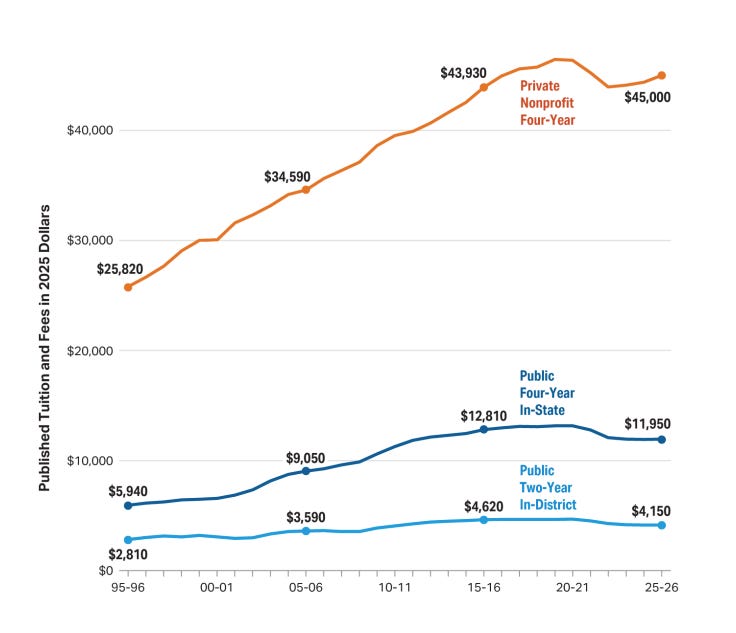
That structure was never a legal requirement. It was an institutional convention built around a specific model of residential education, and it has been remarkably stable for a remarkably long time. What has changed is the cost. In 1980, the average annual cost of a 4-year public university, adjusted for inflation, was approximately $10,000. Today it exceeds $27,000 at public institutions and $58,000 at private ones, according to College Board data. The 4-year timeline that once represented a manageable financial commitment now represents, for many families, a quarter-million-dollar decision whose return on investment is increasingly uncertain. Students nowadays, more concerned about time and money, are looking for alternatives.
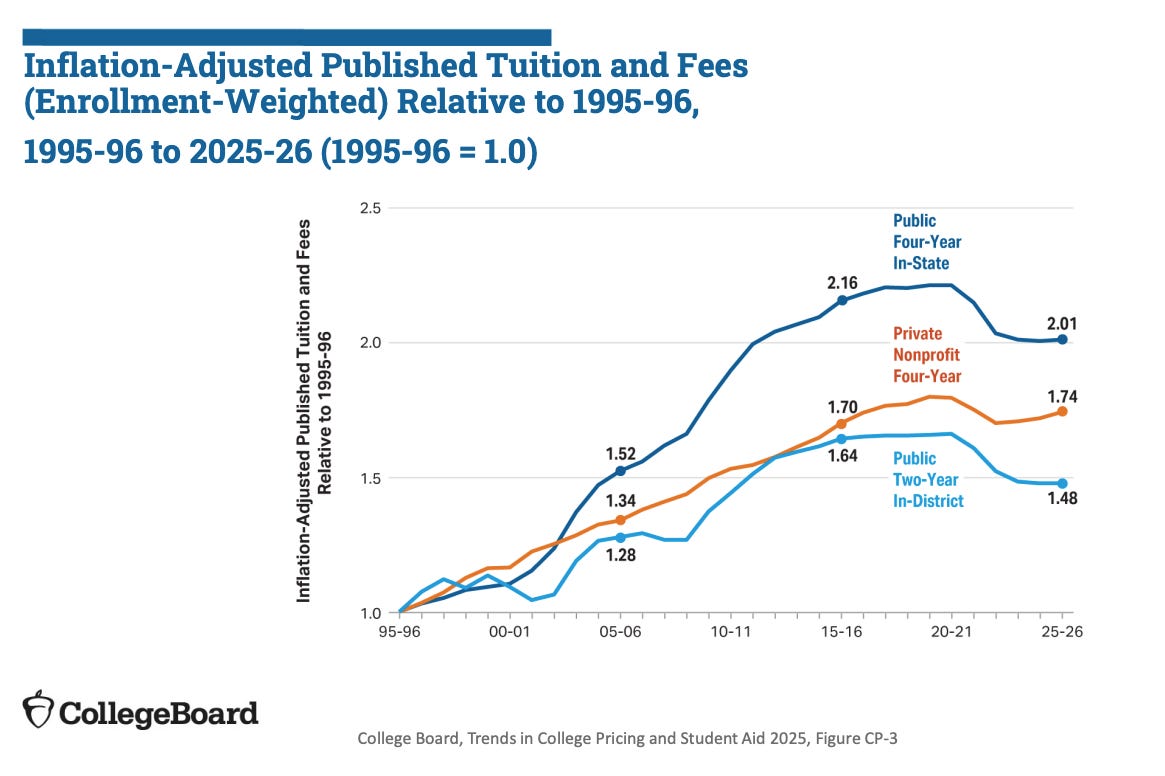
The alternative they are finding on Facebook, Instagram, TikTok, and increasingly in counseling offices goes by the name “degree hacking”, and while the terminology is new, the mechanisms are not. What has changed is the scale, the sophistication of the platforms building around it, and the speed at which families are arriving in IEC offices with specific questions about programs most counselors have never heard of.
The landscape: what degree hacking actually consists of
The credit acceleration toolkit available to students in 2026 is broader and more accessible, and it breaks down into a set of distinct mechanisms that operate differently and carry different institutional acceptance rates, strategic implications, and risk profiles.
The oldest and most established mechanism is the College-Level Examination Program, CLEP, which the College Board established in 1967. These are standardized exams covering subjects typically taught in the first 2 years of an undergraduate degree, and they allow a student who can demonstrate mastery of that material, however they acquired it, to earn college credit without sitting in a classroom. There are currently 34 CLEP exams available, covering subjects from American Government to Introductory Sociology to Spanish. The current exam fee is $97 for the 2025-2026 testing year, covering on average 3 college credits, a straightforward comparison against a course that might cost $1,500-$3,000 in tuition. The College Board reports that approximately 2,900 colleges and universities accept CLEP credits, though acceptance policies vary widely and the maximum number of CLEP credits an institution will accept toward a degree differs significantly from school to school. Online schools and large public universities often have the most generous acceptance policies, with institutions like UMass, UCF, and the University of Arizona leading the pack.
The practical preparation pathway most families encounter is Modern States, a nonprofit that offers a digital library of 32 free online courses designed specifically to prepare students for CLEP exams. According to Modern States, more than 600,000 learners have taken its courses, with 140,000 CLEP exams attempted for an estimated tuition saving of $175 million. Students who complete a Modern States course can also take the corresponding CLEP exam for free, a significant incentive that has driven substantial adoption among cost-conscious families.
Previously earned credits, through AP exams during high school, CLEP exams, or Dual Enrollment courses taken while still a secondary student, compound the advantage significantly. AP and Dual Enrollment are traditional high school courses, taught by the high school teacher, in which students earn college credits either by taking a College Board exam or by purchasing the credits from a partner college. A student who enters college with 15-30 credits already banked has compressed her timeline before her first day of college classes, and can add to that lead through self-paced exams and competency-based coursework simultaneously. The effect is additive and, for motivated students with a clear plan, substantial.
Beyond CLEP, a set of companies has emerged that occupies an unusual middle space in the credit ecosystem. Coopersmith Career Consulting is the most widely known of these, and it is worth understanding in some detail because its model has become the template for the broader category. Coopersmith offers both the exam and the correlated study materials for each subject, with preparation packages that typically average around 300 slides and five hours of lecture content per course. A motivated student can work through the material and sit the exam in a matter of weeks, earning three college credits in a fraction of the time a traditional course would require. Companies like Community Testing Center and Testing and Training International operate on a similar model, using Coopersmith materials and partnering with accredited colleges and universities. Through their programs, a student can self-study, pass the corresponding exam, and earn credits that transfer to their partner schools, and may transfer to other colleges as well, though that is not guaranteed. Following their plan of study can often result in a bachelor’s degree in 12-16 months. The Sara Schenirer Institute, to take one example, advertises a 16-month Bachelor of Arts in Psychology, with the actual degree granted through a partner institution, The University of Mount St. Vincent or St. Peter’s University. Lynn University and Southern New Hampshire University are two well-known institutions that explicitly advertise online programs allowing students to transfer in credits covering up to 75% of their degree requirements, a significant structural openness to the credits these pathways produce.
Another pathway is through the local community college. Students can often take lower-level college courses while still enrolled in high school, allowing them to accrue credits before their official college journey begins. In some regions, high schools permit students to pursue an Associate’s Degree prior to completing high school, a pathway known as Concurrent Enrollment, which differs from Dual Enrollment in that these courses include college-age students rather than only high schoolers, and are usually offered on the college campus or online rather than in the high school classroom.
The institutional response: 90-credit degrees are no longer theoretical
Colleges have watched this trend develop and have begun responding, some out of genuine pedagogical interest, more out of enrollment pressure. The 90-credit bachelor’s degree, which aligns the American credential more closely with its Counterparts overseas have moved from a fringe conversation to an active regulatory agenda in the past 18 months.
The College-in-3 Exchange, a nonprofit coalition founded in 2021 whose stated mission is “reimagining undergraduate education to increase student success while decreasing student costs”, had 60 member institutions as of the most recent data. Most are still awaiting accreditation for their 3-year programs, but the accreditation environment has shifted materially. As of summer 2025, all 7 institutional accreditors in the United States have opened the way for institutions to submit programs of less than 120 credits for review, removing what had been the structural barrier to sub-120-credit degrees at most institutions.
The state-level action has followed. Indiana passed legislation in 2024 requiring all public bachelor’s-granting institutions in the state to develop at least one 3-year bachelor’s degree program. North Dakota’s State Board of Higher Education approved 90-credit bachelor’s degree pilot programs in February 2026, with the pilot running from fall 2026 through summer 2030. The California State University Board of Trustees approved three bachelor’s degrees between 90 and 119 credits on May 6, 2026. The University of Maine System became the first public university system in that state to approve 3-year bachelor’s degrees in July 2025. Johnson and Wales University launched both campus-based and online 3-year degree programs in fall 2025 in Computer Science, Criminal Justice, Graphic Design, and Hospitality Management. Hawaii Pacific University has announced a 3-year Bachelor of Science in Global Business launching fall 2026.
This is not a marginal or fringe development. It is happening at regional accreditors, at state boards of higher education, at well-known institutions, and at the policy level in multiple states simultaneously. The question for IECs is no longer whether these programs will exist in meaningful numbers, they already do. The question is how to advise clients who are asking about them.
The concern: what serious educators are worried about
Not everyone in higher education is celebrating. The president of the Council of Independent Colleges, Marjorie Hass, representing more than 300 liberal arts colleges and universities, stated plainly: “We want diplomas that mean something. I would prefer to have some of these degrees called something other than a bachelor’s”. The president of the New England Commission of Higher Education raised similar concerns about the educational integrity of ultra-accelerated programs. Christie Williams, a North Carolina human resources executive who completed her degree in approximately 3 months by accumulating credits through web tutorials and online classes, has become a frequently cited example of the phenomenon, celebrated in some quarters, held up as a cautionary tale in others.
The concerns are legitimate and IECs should understand them rather than dismiss them. A student who earns 120 credits by passing a sequence of subject-matter exams has demonstrated content knowledge across a range of domains. She has not necessarily developed the analytical writing, collaborative problem-solving, research practice, or mentored intellectual relationship that 4-year residential education, at its best, provides. Whether those experiences are worth the additional cost and time is a judgment that depends on the student, her intended career, her financial situation, and her plans beyond the bachelor’s degree. But the judgment requires that the question be asked clearly, not avoided.
The graduate school question is particularly acute. Much about the long-term implications of 3-year and accelerated degrees remains unsettled. Employers’ responses are still being formed. Graduate and professional school admissions offices are developing their positions. An IEC who advises a family to pursue a degree completion pathway optimized for speed, without addressing what happens when that student applies to medical school or law school or a top MBA program with an accelerated bachelor’s degree in hand, is providing incomplete guidance.
6700+ people read this 2-3 times a week to focus on the How. Most readers subscribed because someone they trusted sent one of my articles to them.
If this article helped you, be that person for someone else (and share it):
What’s in the paid section?
The degree hacking trend is producing real financial savings for real families at a moment when college costs have become genuinely unsustainable for a significant portion of the population. It is also producing credentials of uneven quality through pathways of uneven credibility. The families pursuing it most aggressively are often the ones with the least institutional knowledge to evaluate what they are signing up for.
Behind the paywall, Corey and the Higher Ed Insights team give you the full practitioner toolkit. If you are fielding questions about degree hacking, and you will be, this is the section that turns those conversations from uncomfortable to confident.
Higher Ed Insights is reader-supported. If you are reading this as a free subscriber and you work in college counseling, financial aid, enrollment management, or high school education, the paid section is written directly for you.
Keep reading with a 7-day free trial
Subscribe to Higher Ed Insights to keep reading this post and get 7 days of free access to the full post archives.
 | A guest post by
|